
Yom Kippurim

(At this time this material is written in note form and helps go though what is Yom Kippur and what is talked about during the day of Yom Kippur.)
Yom Kippurim (H3725) plural= “Day of Atonements” or “Day like Purim” (Purim = lots; also is a time of victory); At-one-ment; sometimes called Yom ha-Kadosh (the Holy Day) and the Day of Judgment.
The days between Rosh-ha’Shanah/Head-of-the-Year and Yom Kippur are called the 10 Days of Awe; it is a time of repentance.
Yom Kippur begins in the 7th Month on the 9th day at evening until nighttime on the 10th day (Lev 23:32; 16:29, 30, 31; 23:27, 28; Num 29:7).
This is the only day of year the High Priest could enter the Holy of Holies, and he did so wearing only white linen (note read Lev 16 after extra notes) (Heb 9:7; Lev 16:1, 2, 3, 4, 5, 6, 7, 8, 9, 10, 11, 12, 13, 14, 15, 16, 17, 18, 19, 20, 21, 22, 23, 24, 25, 26, 27, 28, 29).
Yom Kippur is a permanent statute (stated 3 times in Lev 16) for the native and alien/foreigner/gentile (Lev 16:29, 31, 34; 23:31).
Yom Kippur is a holy convocation/reading/assembly (Num 29:7).
There are 7 shabbat shabbathon (High Shabbat) days: the 1st day of Sukkot/Feast-of-Tabernacles/Booths (Lev 23:34, 35); the 8th day after Sukkot/Feast-of-Tabernacles/Booths (Lev 23:36, 39); the 1st and the 7th day of Pesach/Passover/Chag-ha’Matzot/Feast-of-Unleavened-Bread (Ex 12:15, 16; Lev 23:6, 7, 8); the day of Shavuot/Feast-of-Weeks/Pentecost (Lev 23:15, 16, 21); the day of Yom-Teruah/Day-of-Trumpet-Blast/Rosh-ha’Shanah/Head-of-the-Year/New-Year-of-Years (Lev 23:24, 25; Num 29:1); and Yom Kippur, which is like a Shabbat of all the Shabbatot.
5 afflictions:
A Jewish wedding day is called a Mini Yom Kippur [ref]. There are 5 afflictions to fast from on Yom Kippur that are the same afflictions of the wedding day (ref: Mishnah Yoma 8:1). There is no eating or drinking for the anticipation of the wedding. There is no washing and bathing because you have already washed and bathed before the day started to be ready for the wedding day. There is no applying lotions or perfumes because you have already applied those and are ready for the wedding day. There is no wearing leather shoes (skins of sacrifice) as white (linen if possible) is worn at the wedding (Believers will wear white linen robes in Heaven) (Rev 19:7, 8, 14). There is no marital relations as you are waiting until you are married at the wedding. Like a bride at the wedding, white is normally worn on Yom Kippur. This is to look forward to the day we are in Heaven with the LORD wearing our white linen robes. In Rev 19:7, 8 we find the Bride/Church clothed in bright white-linen, because through YESHUA they and all their sins were made white as snow (Psm 51:7; Isa 1:18). Every priest wore white-linen garments (Ex 28:39; 39:27, 28, 29) [ref]. And, the Body-of-YESHUA/Church/Bride is called a Kingdom of Priests (Rev 1:6; 5:10; 20:6).
This is also a day of dying to self for the LORD, so there is also symbolism of our dying to self in the 5 afflictions. In a Jewish burial, the dead are wrapped in white linen (Mt 27:59; Mrk 15:46; Luk 23:53; Jhn 19:40) [ref]. Also, the dead do not eat, drink, wash, bathe, apply lotion or perfumes, or have marital relations.
Click here to see the Jewish Wedding and its symbolism.
Yisra’el/Israel gets to Mount Sinay/Sinai at Ex 19:1 and leaves at Num 10:12. This gives us Leviticus chapter 16 as the middle of the time at Mount Sinay/Sinai with Leviticus being the middle book of the Torah. This leaves us with the center of focus being on the events of Yom Kippur. (Lev 10:16 is sometimes considered the center of the Torah, but this is obtained by finding the middle 39th pair of the 77 double words of the Torah. So, Abraham, Abraham would be a double word in Gen 22:11. “Darash darash” is the 39th double word set in Lev 10:16 with darash (H1875) meaning to “to seek.”) Leviticus 16 is about how to enter into the Holy of Holies where the presence of the LORD is upon the mercy seat of the Ark of the Covenant (Lev 16:2).
As you read Leviticus 16 keep these things in mind:
Hebrew is written with consonant only with memorized vowels. So, a word can be read with different vowels to have a slightly different meaning that still fits the Scripture.
The “bull” is the Hebrew word par (H6499) and is similar to the Hebrew word para (H6500 or H6509) that means to “bear fruit.” In verse 3, the Hebrew makes sure to state it is the “son of an ox” that is being offered (I know this is not translated in the English, so sad) (Lev 16:3).
“Sin offering” is the Hebrew word chaththa’ah (H2403) that means “sinful thing” or “sin.”
The Hebrew word for “ram” is ‘ayil (H352) that means “strength/strong,” “ram,” “leader/chief,” “pillar/door-post,” “mighty tree.”
The Hebrew word for “burnt offering” is ‘alah (H5928) or ‘olah (H5930) that can also mean “ascent” and is similar to the Hebrew word ‘ala (H5927) that means “go-up/ascend” and ‘aleh (H5929) that means “leaf/leafage/foliage.”
The Hebrew word for “white linen” is bad (H906), and the Hebrew words bad (H905) means “alone/separation,” bad (H907) means “lie/liar,” bada’ (H908) means “devise/invent.” This all sounds kind of bad (lol) for linen that is suppose to represent a Believer’s righteous acts (Rev 19:8). The linen garment places a separation/division between the person and everyone else. The white part of the linen is the added confusion. The LORD is the light of the world (1 Jhn 1:5; 8:12). We can also say the Sun that gives off white light is a light to the world. So, white in Shamayim/the-Heaven(s) is representing the righteousness of the LORD and the black of darkness in Shamayim/the-Heaven(s) is representing the absence of light representing the LORD and HIS righteousness. But, on ‘Aretz/Earth white is the absence/reflection of light and creatures who live in the dark away from the light are white, while black is the absorption/fullness of all the colors of white light [ref]. ‘Aretz/Earth is in a fallen state (Rom 8:22). So, the light being absorbed by something black on ‘Aretz/Earth shows its fallen state of darkness, while white is dressing the fallen state of something on ‘Aretz/Earth with a lie of what looks like the righteousness of Shamayim/the-Heaven(s). In Shamayim/the-Heaven(s) the white linen really does represent the righteous acts of the saints, but what about on ‘Aretz/Earth? The lost unbeliever wearing white linen reminds me of the statement of YESHUA, “whitewashed tombs” (Mt 23:27). And, a Believer is called holy even before they die physically and go to Shamayim/Heaven, meaning they could wear white linen without it being a lie (1 Cor 3:17; 1 Pet 2:9).
The singular of Yom Kippurim is kippur (H3722) that means to “cover-over/atonement” or “pitch it with pitch”; similar to kapar (H3723) that means “village,” or koper (H3724) that means “pitch” or “the price of a life” or “ransom/redeem” or “bribe” or “village.” Yes, the covering of pitch upon Noach’s/Noah’s Ark is the same. (And yes, the p is a ph sound in some of the words, just trying to keep it simple.)
Kapporet (H3727) means “propitiatory”; the lid where the blood was placed was also called kapporet or the mercy seat in English. This is explained more below.
Qorban (H7133) is a “sacrifice/offering.” The “n” of qorban can be a suffix for “their” added to the word qerab (H7128/H7129) meaning “battle” or “war,” or qereb (H7130) meaning “inward part,” or qareb (H7131) meaning “come-near/approaching,” or qarab (H7126) and qereb (H7127) meaning “come near,” or qarob (H7138) meaning “near.” It is through the sacrifice we are brought near to the LORD through battle/war.
The Hebrew word for “goat” is ‘ez (H5795/H5796) that is similar to the Hebrew word ‘az (H5794) meaning “strong/harsh” and ‘oz (H5797) meaning “strength/might.” The Hebrew word ‘azal (H235) means “to-go-away/disappear/fail/be-gone/be-spent.” So, the first part of of the Hebrew word ‘aza’zel (H5799) translated “scapegoat” is the word for “goat,” and the last part is “to-go-away/disappear/fail/be-gone/be-spent.”
The Hebrew word translated as “let-it-go” is shalach (H7971) meaning “send/let-go.” Shelach (H7972) means “sent/to-send” or (H7973/H7974) meaning “spear/missile/weapon-of-attack/sprout/shoot” as in the shoot of Yishay/Jesse in Isa 11:1.
“Wilderness” is the Hebrew word midbar (H4057) and also means “mouth.” From the article “The Flesh“: The mouth is a dark bottomless pit of death that is used to continuously sacrifice food (that was once alive) in order to give life to the body. Several times the Lake-of-Burning-Fire-and-Sulfur/Hell/The-2nd-Death is called the Place of Gnashing of Teeth (Rev 20:14; 21:8; Mt 8:12; 13:42, 50; 22:13; 24:51; 25:30; Luk 13:28). The mouth then represents the Lake-of-Burning-Fire-and-Sulfur/Hell/The-2nd-Death, a place of continuous suffering/sacrificing.
The Hebrew word for “7” is sheva’ (H7651) is similar to the words shava’ (H7650) meaning “to-swear/take-an-oath,” shiv’ah (H7653) meaning “fullness/satisfaction/satiety,” shav’ah (H7654) meaning “full/satisfy/satisfaction/enough.”
(From all this you should be able to see the entire process and picture of the death and resurrection of YESHUA. Below also explains more to get the full picture. There is more when I have time to add it.)
(Lev 16:1, 2, 3, 4, 5, 6, 7, 8, 9, 10, 11, 12, 13, 14, 15, 16, 17, 18, 19, 20, 21, 22, 23, 24, 25, 26, 27, 28, 29, 30, 31, 32, 33, 34)
Need to also read “The Flesh” to understand the Altar.
From “When was YESHUA’s Ministry, Death, and Resurrection?“:
We know from (Yoma 39b:5-6) the doors to the Temple (that were supposed to be always be closed and were continually trying to be closed by the Jews every day for 40 years) were opened every day for 40 years; and the fire of the servant light (that was never to go out and the Jews tried everything to keep it lit every day for 40 year) went out every day for 40 years before the 2nd Temple was destroyed; and the lot of the scapegoat of the Yom Kippur (Day of Atonement) sacrifice (Lev 16:8) always fell to Azazel/scapegoat in the right hand for 40 years before the 2nd Temple was destroyed (like flipping a quarter 40 times and always getting tails); and the scarlet ribbon tied around the scapegoat’s neck along with the priest’s blood stained garments, covered in blood from the sacrifices, did not turn white for 40 years before the 2nd Temple was destroyed, as they had turned white before this 40 years. If you go with 70 AD for the destruction of the Temple, then 30 AD is the year all this started (when YESHUA died on the Cross, died, was buried, and then arose from the dead).
This shows us the high priest’s blood stained garments were supposed to turn white, the scarlet ribbon was supposed to turn white, and the lots were not a thing of chance but of order with the starting sacrifice of the LORD supposed to be on the right just as Hebrew is written and read from right to left and just as ‘Aretz (Earth) turns from the right to the left if you are facing the Sun toward the south.
The scarlet ribbon was a wool string dyed red from a crushed worm [ref]. This symbolism can be further studied HERE.
LEV 17:11 ‘For the life of the flesh is in the blood, and I have given it to you on the altar to make atonement for your souls; for it is the blood by reason of the life that makes atonement.’ LEV 17:12 “Therefore I said to the sons of Israel, ‘No person among you may eat blood, nor may any alien who sojourns among you eat blood.’
The subject of blood can be studied more HERE: Blood.
As written in Lev 10:10 and Ezek 44:23, the Torah and commandments teach what is holy and profane and unclean and clean. In Genesis, the LORD made separations and set apart the clean and holy from the unclean and profane (light from the darkness). The LORD has set us apart to be holy as HE is holy and to be set apart from the unclean and profane (Lev 11:44, 45; 19:2; 20:7, 26; 21:8; Dt 23:14; 1 Peter 1:15, 16).
The cleansing of the Leper in Leviticus chapter 14 also is very similar to Leviticus chapter 16.
The Yovel/Jubilee is also announced on Yom Kippur as stated in Lev 25:9 with the “cross-over/pass-over shophar” (Lev 25:8, 9, 10, 11, 12, 13, 14, 15, 16, 17, 18, 19, 20, 21, 22, 23, 24, 25, 26, 27, 28, 29, 30, 31, 32, 33, 34, 35, 36, 37, 38, 39, 40, 41, 42, 43, 44, 45, 46, 47, 48, 49, 50, 51, 52, 53, 54, 55).

Readings:
Lev 16:1, 2, 3, 4, 5, 6, 7, 8, 9, 10, 11, 12, 13, 14, 15, 16, 17, 18, 19, 20, 21, 22, 23, 24, 25, 26, 27, 28, 29, 30, 31, 32, 33, 34; Num 29:7, 8, 9, 10, 11; Lev 18:1, 2, 3, 4, 5, 6, 7, 8, 9, 10, 11, 12, 13, 14, 15, 16, 17, 18, 19, 20, 21, 22, 23, 24, 25, 26, 27, 28, 29, 30; Isa 57:14, 15, 16, 17, 18, 19, 20, 21; 58:1, 2, 3, 4, 5, 6, 7, 8, 9, 10, 11, 12, 13, 14; Micah 7:18, 19, 20; Jonah 1:1, 2, 3, 4, 5, 6, 7, 8, 9, 10, 11, 12, 13, 14, 15, 16, 17; 2:1, 2, 3, 4, 5, 6, 7, 8, 9, 10; 3:1, 2, 3, 4, 5, 6, 7, 8, 9, 10; 4:1, 2, 3, 4, 5, 6, 7, 8, 9, 10, 11; Hebrews
Below are normal readings for Yom Kippur
Kol Nidrei:
Nullify Vows: We will not be doing this, but it does points to the husband (YESHUA) nullifying the vows of the wife (the Church) (Num 30:6, 7, 8).
Claim Num 15:26 for an error and Num 14:17, 18, 19, 20, 21 for asking pardon
Kaddish (modified):
Magnified and sanctified is YEHOVAH, the great Name of GOD, throughout the world which was created according to HIS Divine will. May HIS kingship in shalom be established speedily in our days, and unto the entire household of Yisra’el/Israel. Amen. May YEHOVAH be praised forever and ever. Glorified and celebrated, lauded and praised, acclaimed and honored, extolled and exalted forever be the Name of the Holy One, far beyond all song and psalm, beyond all hymns of glory which mortals can offer. Amen. The chastening of YESHUA on the Cross by our LORD the FATHER has brought us shalom that we claim in abundance from Heaven with life’s goodness for us, and may this also be true for all the people Yisra’el/Israel. Amen. This shalom HE has given us be manifested in our lives and upon all that belongs to us as we pray YOU oh LORD help us to increase in faith in believing the truth of YOUR peace in our lives. May HE who makes shalom in his high holy places make shalom for all of Yisra’el/Israel. Amen.
Shema:
Dt 6:4, 5, 6, 7, 8, 9; Dt 11:13, 14, 15, 16, 17, 18, 19, 20, 21; Nm 15:37, 38, 39, 40, 41
Dt 6:4 Hear/Obey Yisra’el/Israel, (the) LORD/YEHOVAH our GOD (the) LORD/YEHOVAH | (is) one.
Dt 6:5 And, you (are) to love [Aleph-Tav] (the) LORD/YEHOVAH your GOD in/with all- your heart/mind and in/with all- your living-flesh/soul and in/with all- your force/muchness.
Dt 6:6 And, [to be HIS]/[they to be] the Words, the these which I lay-on/give-charge/command you today/the-day, upon- your heart/mind.
Dt 6:7 And, you (are) to sharpen/pierce/teach/inculcate (them) to your children/sons and you speak/talk with them in your sitting/dwelling in/with your house/family and in your going/walking in the-way/road and in your laying-down and in your rising-up.
Dt 6:8 And, you (are) to bind/tie/league-with (them) to/for-(a) mark/sign upon- your hand&arm and [to be HIS]/[they to be] for you to bind/band/go-around between your eyes.
Dt 6:9 And, you (are) to inscribe/write (them) upon- doorposts/gateposts (of) your house/family and in/by/with your gates/openings/gateways.
Dt 11:13 And, will be if- you will hear/obey, (truly) hear/obey, GOD/toward/to/these- MY instructions/commandments that/which/WHO I instruct/command, [your Aleph-Tav], today/the-day, to love [Aleph-Tav]- (the) LORD/YEHOVAH your GOD and to work-for/worship/serve HIM in/with all- your heart/mind and in/with all- your living-flesh/soul.
Dt 11:14 And, I (will) bestow/ascribe/give rain- (to) your earth/land in its time/season, early-rain/spring-rain and latter-rain/autumn-rain, and you gather/harvest your grain/increase and your fresh-grape-juice/new-wine and your fresh-oil.
Dt 11:15 And, I (will) bestow/ascribe/give vegetation/herbage in your field/land for your livestock/animals and (for) you to eat and you to be satisfied/filled-to-satisfaction.
Dt 11:16 (You) keep/guard/watch/preserve/protect it/HIM to/for yourselves lest (you) will be open/deluded to your heart/mind and you turn-aside/turn-away/depart and you serve/work-for/worship another/other gods and you are made (to) bow-down/worship/fall-down to/for them.
Dt 11:17 And, burn/kindled-with-anger (the) nostril/nose/face- (of the) LORD/YEHOVAH in/on you and restrain/hold-back [Aleph-Tav]- the Heaven(s) and there will not- be rain and the soil/ground/land not bestow/give/yield [Aleph-Tav]- produce/fruit/wealth/increase and you perish/wonder-away/lose-oneself quickly/swiftly/in-haste from upon the earth/land the good/best/pleasant that/which/WHO (the) LORD/YEHOVAH bestows/gives to/for you.
Dt 11:18 And, you place/set/put [Aleph-Tav]- MY WORD, these/GOD, upon- your heart/mind and upon- your living-flesh/soul and you bind/tie/league-with [Aleph-Tav] them to/for-(a) mark/sign upon- your hand&arm [to be HIS]/[they to be] for you to bind/band/go-around between your eyes.
Dt 11:19 And, you teach/goad/instruct/train [Aleph-Tav] them [Aleph-Tav]- (to) your children/sons to talk/speak with them in your sitting/dwelling in/with your house/family and in your going/walking in the-way/road and in your laying-down and in your rising-up.
Dt 11:20 And, you (are) to inscribe/write (them) upon- doorposts/gateposts (of) your house/family and in/by/with your gates/openings/gateways.
Dt 11:21 To/For (the) purpose/intent they will increase/multiply your days and (the) days (of) your children/sons upon the soil/ground/land that/which swore/sevened (the) LORD/YEHOVAH to/for your fathers <to assign>/<through mark of t> for/to them, like (the) days (of) the Heaven(s) upon- the Earth/’Aretz.
(<to assign>/<through the mark of t>: The word is tt. The word does not exists in the understood Hebrew. Translators are saying it is the word ntN that means ‘give/bestow/assign.’)
Nu 15:37 And, the-LORD/YEHOVAH spoke to Moshe/Moses to say,
(The verses below are not done yet)
Nu 15:38 “Speak to (the) Sons (of) Yisra’el/Israel and say to them to make for themselves tzitzit/tassels/tuft-of-hair upon (the) corner/wing/end in their coverings/garments/clothing (to their generations/descendants) (and give it/Him) (upon) (tassels/tuft of hair) (the corner/wing/end) (string/[be crooked]) (blue-dye).
Nu 15:39 (An be) (to you(pl)) (to tassels/tuft of hair) (and see) (the it/Him) (and remember(pl)) (the) (all) (instructions) (LORD) (and do them) (the them) (and not) (search out/explore it) (after/behind (ME)) (your heart/mind) (and after/behind (Me)) ((My) your eyes) (that/which/who/walk/step/guide/be blessed) (yourselves/the them) (become prostitute) (after/behind (MY) them).
Nu 15:40 (To account) (remember it/Him) (and do them) (the) (all) (MY instructions) (and be My them) (holy(pl)) (to your GOD).
Nu 15:41 (I) ([am] the LORD) (your GOD) (Who/that/walk/step/guide/be blessed) (Who/the/a/? brought out I) (you) (of earth) ([of] egypt/Ham/of Tyre/adversary/flint) (to be(pl)) (to you) (before/to GOD) (I) ([am] the LORD) (your GOD).
(added words for clarification); alt-definition/alternative-def; [Aleph-Tav] is in the text, but is never shown or translated in English translations. YESHUA calls HIMSELF the Aleph-Tav/Alpha-Omega.
Amidah- 19 Blessings
Many of these readings need updated for the Believer in YESHUA as a Believer has every blessing in the Heaven(s) through the SPIRIT in YESHUA as Eph 1:3 states: “Worthy-of-praise/blessed (is) the GOD and FATHER the/of-the LORD/Master of us, YESHUA/JESUS MESSIAH/CHRIST, the (ONE) having blessed us with/in/by every spiritual/supernatural blessing/gift/benefit/praise in/by/with the heavenly-realms/spiritual-sphere/supernatural in/on/by/with MESSIAH/CHRIST.”
Al Chet (Confession):
For the sin which we have committed before You under duress or willingly.
And for the sin which we have committed before You by hard-heartedness.
For the sin which we have committed before You inadvertently.
And for the sin which we have committed before You with an utterance of the lips.
For the sin which we have committed before You with immorality.
And for the sin which we have committed before You openly or secretly.
For the sin which we have committed before You with knowledge and with deceit.
And for the sin which we have committed before You through speech.
For the sin which we have committed before You by deceiving a fellowman.
And for the sin which we have committed before You by improper thoughts.
For the sin which we have committed before You by a gathering of lewdness.
And for the sin which we have committed before You by verbal [insincere] confession.
For the sin which we have committed before You by disrespect for parents and teachers.
And for the sin which we have committed before You intentionally or unintentionally.
For the sin which we have committed before You by using coercion.
And for the sin which we have committed before You by desecrating the Divine Name.
For the sin which we have committed before You by impurity of speech.
And for the sin which we have committed before You by foolish talk.
For the sin which we have committed before You with the evil inclination.
And for the sin which we have committed before You knowingly or unknowingly.
For all these, GOD of pardon, pardon us, forgive us, atone for us.
For the sin which we have committed before You by false denial and lying.
And for the sin which we have committed before You by a bribe-taking or a bribe-giving hand.
For the sin which we have committed before You by scoffing.
And for the sin which we have committed before You by evil talk [about another].
For the sin which we have committed before You in business dealings.
And for the sin which we have committed before You by eating and drinking.
For the sin which we have committed before You by [taking or giving] interest and by usury.
And for the sin which we have committed before You by a haughty demeanor.
For the sin which we have committed before You by the prattle of our lips.
And for the sin which we have committed before You by a glance of the eye.
For the sin which we have committed before You with proud looks.
And for the sin which we have committed before You with impudence.
For all these, GOD of pardon, pardon us, forgive us, atone for us.
For the sin which we have committed before You by casting off the yoke [of Heaven].
And for the sin which we have committed before You in passing judgment.
For the sin which we have committed before You by scheming against a fellowman.
And for the sin which we have committed before You by a begrudging eye.
For the sin which we have committed before You by frivolity.
And for the sin which we have committed before You by obduracy.
For the sin which we have committed before You by running to do evil.
And for the sin which we have committed before You by tale-bearing.
For the sin which we have committed before You by swearing in vain.
And for the sin which we have committed before You by causeless hatred.
For the sin which we have committed before You by embezzlement.
And for the sin which we have committed before You by a confused heart.
For all these, GOD of pardon, pardon us, forgive us, atone for us.
And for the sins for which we are obligated to bring a burnt-offering.
And for the sins for which we are obligated to bring a sin-offering.
And for the sins for which we are obligated to bring a varying offering [according to one’s means].
And for the sins for which we are obligated to bring a guilt-offering for a certain or doubtful trespass.
And for the sins for which we incur the penalty of lashing for rebelliousness.
And for the sins for which we incur the penalty of forty lashes.
And for the sins for which we incur the penalty of death by the hand of Heaven.
And for the sins for which we incur the penalty of excision and childlessness.
And for the sins for which we incur the penalty of the four forms of capital punishment executed by the Court: stoning, burning, decapitation and strangulation.
For [transgressing] positive and prohibitory mitzvot, whether [the prohibitions] can be rectified by a specifically prescribed act or not, those of which we are aware and those of which we are not aware; those of which we are aware, we have already declared them before YOU and confessed them to YOU, and those of which we are not aware — before YOU they are revealed and known, as it is stated: The hidden things belong to the LORD our GOD, but the revealed things are for us and for our children forever, that we may carry out all the words of this Torah. For YOU are the Pardoner of Yisra’el/Israel and the Forgiver of the tribes of Yeshurun in every generation, and aside from YOU we have no king who forgives and pardons.
(This section is from the Tzitzit article.)
Angel of the LORD
We know the Angel of the LORD is YESHUA. The Hebrew word keruv (cherub) is singular for a type of angel with keruvim (cherubim) being the plural for that type of angel [H3742]. YESHUA being the Angel of the LORD is why the tekheleth-wool (blue-wool), ‘argaman-wool (Tyrian-purple-wool), and tola’at-shani-wool (scarlet/crimson/red wool) that represents YESHUA was used to embroider keruvim/cherubim/angels into the white-linen covering of the Tabernacle and the white-linen veil/door between the 2 rooms of the Holy Place and the Holy of Holies (Ex 26:1, 31; 36:8, 35).
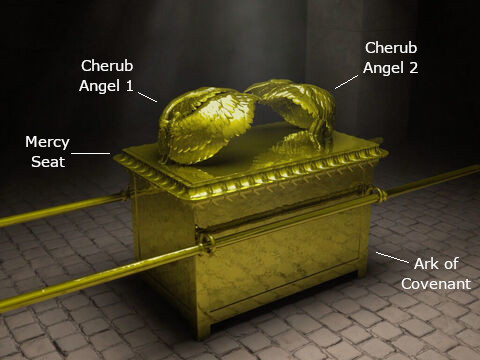
And, 2 keruvim/cherubim/angels are one piece with the hakkapporeth (the mercy seat), which is the lid for the Ark of the Covenant, with the keruvim/cherubim/angels on both ends of the Ark of the Covenant (Ex 25:19, 20; 37:8, 9). The hakkapporeth is the singular form of the Hebrew word translated in English as propitiatory/the-mercy-seat (H3727) with the Hebrew word hakkippurim (H3725) being the same Hebrew word with different vowels in the plural form meaning atonements. ‘Yom Hakkippurim’ is the Hebrew phrase for the ‘Day of Atonements’ (Lev 23:27). So, this lid of the Ark of the Covenant can be called the-propitiatory/the-atonement/the-covering-over/the-mercy-seat and is where the blood from the Yom-Hakkippurim/Day-of-Atonements sin offering/sacrifice was sprinkled to make atonement for all of the people (Lev 16:11, 12, 13, 14, 15, 16, 17). Also remember, the 2nd set of unbroken/eternal new covenant stone tablets were brought down the mountain by Mosheh/Moses to the people on Yom-Hakkippurim/The-Day-of-Atonement. And, YESHUA is called the Propitiation/Atonement/covering-over of our sin (1Jhn 2:2; 4:10; Rom 3:25;). “The wages/salary/reward of sin/missing-the-mark/failure is death” (Rom 6:23). YESHUA paid the wages of our sin to redeem us from death and cover-over our sin. This means the lid of the Ark of the Covenant is representing YESHUA. But, this also means the 2 angels that are one piece with the lid/mercy-seat are also representing YESHUA. Does this mean YESHUA is an angel? All the Bible/Scripture/Word speaks of YESHUA as the one LORD GOD; so, YESHUA can not be an angel. So, what is going on? The Hebrew word for angel is mal’ak (H4397) and literally means messenger. The Hebrew word for king is melek (H4428). The difference between the two words is the word for king has its vowels changed from ‘e’ to ‘a’ and an Aleph (‘) is added. Both of these changes are moving the word for king toward Aleph, as the Aleph is used as the vowel of ‘a’. Aleph is the first letter of the Hebrew alphabet and represents the LORD (see Aleph). So, we could translate mal’ak as the messenger-of-the-LORD/king-from-the-LORD. This makes sense with angels and the Angel of the LORD. But, in Hebrew there is not an “of the” in the phrase “Angel of the LORD.” So, the phrase “Angel of the LORD” could be translated as Messenger-YEHOVAH/KING-YEHOVAH, which is very fitting for our LORD KING YESHUA. So, why the keruv/cherub (H3742)? In Hebrew words can be broken down into a sentence/statement. If you look up the first word of the Bible in Hebrew on YouTube, you will find many 15 minute to 1 hour discussions about this one word (very good material if you have never looked that up, but there are opinions dropped into the discussions that might not be biblical. So, always test what is said in light of the Scripture. That is true of even WhyAlive. That is why we have placed all the references in our material.) If you take the first part of kerub, the kr, this can be the Hebrew word kar (H3733) meaning a ram/he-lamb. If you take the rb of kerub, this can be the Hebrew word rab (H7227) meaning chief/captain/mighty. But, we always have 2 keruvim/kerubim/cherubim. The ru_m of keruvim is the Hebrew word rum (H7311) that means to lift-up/rise-up/be-exalted. The ‘b/v’ by itself can mean in/with/by, and the Hebrew letter has a meaning of a tabernacle/tent/house/family/body (see Bayit) [30]. The ‘b/v’ is in the middle of the word rum/rise-up; so, ‘b/v’ is ‘in’ the lifting-up or the tabernacle/body is in the lifting-up/rising-up/being-exalted. So, altogether in the word kerub/cherub/kerubim/cherubim we have the Chief/Mighty Ram WHO is lifted-up/rising-up/being-exalted. The Hebrew word for ark, as in Ark of the Covenant, is ‘aron (H727) and means ark/chest/coffin. This Ark/coffin is made out of wood from the shittim (acacia) thorn tree (Ex 25:10). And, both the broken and unbroken stone tablets of the Word/Torah/Scripture were buried in this Ark/coffin that has a name that is similar to the first high priest, ‘Aharon (Aaron) (H175) (Ex 30:30). But, the Lid/Covering-Over/Mercy-Seat is made of pure gold (Ex 25:17).
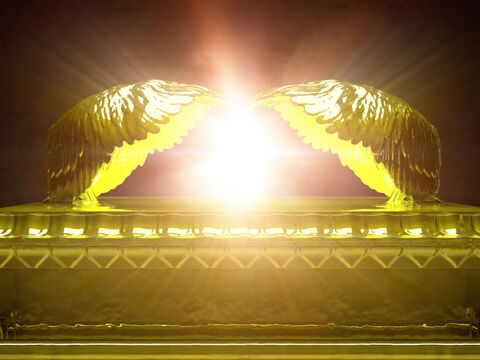
Gold increases in amount as you move from the courtyard to the Holy of Holies toward the place to meet the LORD on top of the pure gold Covering-Over/Mercy-Seat between the pure gold wings of the keruvim/cherubim/angels (Ex 25:1-27:21; 30:1, 2, 3, 4, 5, 6; 25:20, 21, 22). The LORD refines and purifies a Believer like gold; so, they might be like vessels of gold, highly lifted up, and produce works of gold (Zech 13:9; Mal 3:3; 1 Cor 3:12; 2 Tim 2:20, 21). And, the final cubed Holy-of-Holies/New-Yerushalaim/New-Jerusalem/The-City-of-Heaven has a city and street of pure gold where the LORD lives/dwells with HIS people and nothing unholy will ever enter into it (Rev 21:1, 2, 3, 4, 18, 21, 22, 23, 27; 22:3, 4, 5).
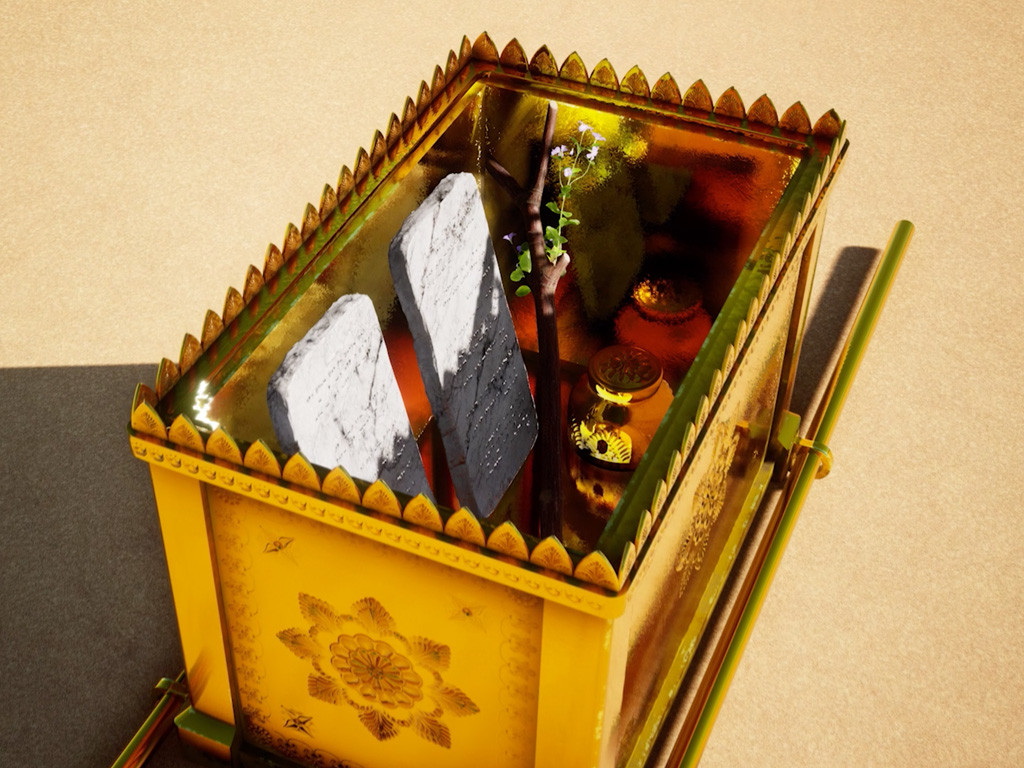
This Image is not complete: There should be 2 broken stone tablets inside the Ark. And, the stone tablets are the wrong shape as explained below in article.
So, the Word on stone tablets, the manna/bread-of-heaven, and the rod of ‘Aharon (Aaron) the high priest with his name on the rod were all buried in a coffin/ark/’aron, named after the high priest ‘Aharon, as these items were placed upon and in the thorn tree coffin representing our sin (Ex 16:33; Num 17:2, 3, 10; Heb 9:4). This is just as YESHUA/the-Word/the-Bread-of-Heaven/the-Rod/the-Staff/the-High-Priest took upon HIMSELF our sin and its death and died as a sin offering/sacrifice upon the Cross (representing our sin as a fallen thorn tree,
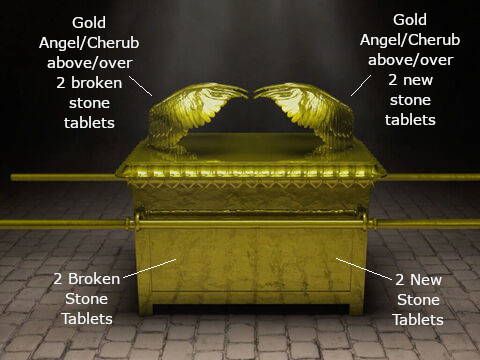
As part of the gold lid/mercy-seat there is one gold keruv/cherub/angel above/over the 1st two broken covenant stone tablets inside the Ark-of-the-Covenant/coffin. And, also as part of the gold lid/mercy-seat there is another gold keruv/cherub/angel above/over the 2nd two unbroken covenant stone tablets that are also inside the Ark-of-the-Covenant/coffin. This is as YESHUA, the Angel-of-Gold/Mal’ak-YEHOVAH/Angel-of-the-LORD/Messenger-YEHOVAH/KING-YEHOVAH being the Cherub/Mighty-Chief-Ram was a golden-cherubim/tabernacle-body-lifted-up/tabernacle-body-arisen-from-the-dead/tabernacle-body-exalted and is our gold-mercy-seat/Atonement/Propitiation/Covering-Over-of-our-sin-and-its-death (over the Ark/coffin) as HE redeemed our lives by paying in full the wages of sin and its death for both the Body-of-YESHUA of the 1st broken old covenant and for the Body-of-YESHUA of the 2nd new eternal covenant (Heb 9:11, 12, 13, 14, 15, 16, 17, 18, 19, 20, 21, 22, 23, 24, 25, 26, 27, 28; 10:1, 2, 3, 4, 5, 6, 7, 8, 9, 10; Rom 4:3, 4, 5, 6, 7, 8; 1 Cor 11:25, 26). Since a Believer in YESHUA is the Body-of-YESHUA and dies to their old sinful self in YESHUA’s death and is resurrected a new creation in YESHUA’s resurrection, the stone tablets of the Word also represent the burying in death of the heart of stone of the Body-of-YESHUA/Believers while they are also being lifted-up/arisen-from-the-dead/exalted as new creations in YESHUA, being refined and purified like the gold of the Mercy-Seat to be like vessels of gold, highly lifted up and produce works of gold (Rom 6:3, 4, 5, 6, 7, 8, 9, 10, 11; 2 Cor 5:17; 2 Tim 2:20, 21).